









Have you ever felt caught between being told it’s too soon to deal with your grief and being told later that you should be over it by now?
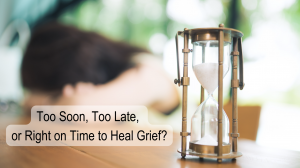
One of the most confusing messages you receive about grief and loss is that there’s a “right time” to deal with it.
At first, you’re told it’s too soon. You shouldn’t look at it yet. The loss is fresh, and you just need time. So you wait. You survive the days. You keep going because that’s what you’re supposed to do.
Then months pass, and the message quietly shifts. Now you’re told that enough time has gone by. That you should be okay. That time heals all wounds. You may even tell yourself, “I’m good now. I’m through it.”
But the truth is, you probably didn’t actually do any grief recovery work during that time.
You may have stayed busy. You may have eaten more, poured another glass of wine at night, scrolled longer, or watched more shows just to shut your brain off. Those distractions can dull pain temporarily, but they don’t help you become emotionally complete with what still hurts.
Grief doesn’t only come from death. Divorce, estrangement from a family member, job loss, changes in health, broken relationships, and unmet expectations are all losses. Each one can create emotional pain, yet very few people are taught what to do with that pain in a healthy way.
If you don’t happen to talk to someone at the exact moment you’re actively grieving, society often convinces you that grief recovery isn’t for you. That you missed your window. That if you didn’t deal with it right away, you should have moved on by now.
The reality is that there is never a wrong time to address unresolved grief.
If something from your past still affects your thoughts, your emotions, or your behavior today, it matters. Unresolved grief does not disappear with time. Instead, it shows up in your life in quieter, more complicated ways.
It can affect how present you are in your relationships. It can affect your ability to trust. It can shape how open or guarded your heart feels. It can influence how you show up at work, how you parent, and how you relate to the people closest to you.
If you are unfinished with a past relationship, it can be difficult to fully invest in the one you are in now. If you are carrying unresolved hurt from how a job ended, it may be hard to stay open and engaged in a new role. If you are unfinished with your own upbringing, that emotional pain can quietly influence how you raise your children, even when you are trying to do things differently.
When grief is left unaddressed, life has a way of bringing it back to the surface. And when that happens, the world usually offers you more distractions instead of real solutions. Very few places invite you to slow down, look honestly at emotional pain, and complete what was left unfinished.
That is why The Grief Recovery Method exists. It’s not about reliving pain or staying stuck in the past. It is about addressing unresolved grief in a structured, practical way so it no longer interferes with your life today.
The Grief Recovery Method is for everyone. Grief is universal. People from all cultures, belief systems, and backgrounds experience loss. When you are given a safe place to speak honestly about what hurts, differences fade away. What remains is shared humanity and the opportunity for healing.
You do not have to wait for the perfect moment. You do not have to be in crisis. You do not have to justify your pain or prove that your loss was significant enough.
If something from your past is still affecting how you live today, that is reason enough to look at it.
Any time is the right time to heal what still hurts.
Want to learn more? Watch our free online grief course today!

Comments
Andrea Roper
I'm trying to stay motivated to continue and find a suitable new therapist to share the work with, & continue - she can witness me read it, and "be a heart with ears". Kim Livingston, a therapist who was on staff in the GRM Call Center a long time ago advised me of this alternative method. I wrote out the Amends, Forgivenesses and Signifigant Emotional Statements assignment regarding my dad that died. I'm trying to find a local therapist (marriage and family therapist) that I feel I can can actually connect with to hear my GRM written assigments. This way, my local insurance can cover the therapy and I can heal for free.
Thanks for writting this urgent article. This gives me hope to continue my search locally, for a therapist with sensory and trauma skill.
Best,
Andrea Roper
(Corona, California : )
Karen Gilroy
this really resonated with me. the too soon / too late trap is something i see constantly in my work with grieving families.
people come to me years after a loss feeling almost embarrassed. like theyve missed their chance. a woman came to me last year, three years after losing her husband, and the first thing she said was "i know i should be over this by now." she wasnt. and thats not a failure. thats just grief doing what grief does when you dont have the tools or the space to actually work through it.
the staying busy thing is so real too. i call it productive avoidance. it looks like coping from the outside but inside nothings moving. nothings shifting.
i think the hardest part is that most people genuinely dont know what "doing the work" even looks like. they think talking about it once or having a good cry should be enough. but grief recovery is more like untangling a knot. you have to go slow and find each thread.
thank you for writing this. more people need to hear that there is no expiry date on healing.
Karen Gilroy
this really resonated with me. i've been working in grief support for close to 30 years now and the number of people who come to me saying 'i thought i dealt with it' is staggering. they didn't deal with it. they survived it. there's a massive difference.
the too soon / too late trap is real. in the early days everyone tells you to just get through the funeral, get through the first christmas, get through the anniversary. and then suddenly a year has passed and people expect you to be fine. but you never actually sat with any of it.
i run a memorial website called myfarewelling.com and one thing i've noticed is that the people who take time to write about their person, to put words to what that relationship meant.. they often tell me it was the first time they actually processed anything. not because writing is magic, but because they finally stopped and looked at it instead of around it.
there really is no wrong time. i've had clients come to me 15 years after a loss and finally break through something they'd been carrying since day one. the grief didn't expire. it was just waiting.
Karen Gilroy
This hits home. I work with clients who carry grief from losses that happened years or even decades ago, and almost every one of them says some version of "I thought I dealt with it." One woman came to me after her mother died. She thought she was grieving her mom. Turns out the real pain was an unresolved divorce from fifteen years earlier that she'd never let herself feel because everyone told her she should be relieved it was over. The grief just waited. I see it with job losses too. A client lost a career he'd built for twenty years and everyone around him jumped straight to "so what's next?" Nobody gave him space to grieve what he'd lost. Three years later it was still affecting every relationship he had. There really is no expiration date on grief work. At MyFarewelling we hear these stories constantly. The bravest thing someone can do is admit that something still hurts.
Add new comment