








Are you lugging around feelings of guilt about someone important to you who died?
Are those feelings hanging around long after you—and others who care about you—think they should be gone? If so, there’s a possibility that what you’re calling guilt is something else.
If guilt isn’t the right word to define what you’ve been feeling, it may be adding to the burden you’re carrying.
Here is how to get rid of feelings of guilt.
Try this little experiment
Think about the person and the reason you’ve been saying that you feel guilty. Then ask yourself, “Is there anything I wish I’d said or done differently? Is there anything I wish the other person had said or done differently? Are there some things I wish had happened better or more often?”
If you answered yes to any of those questions, then it’s very likely that guilt is the wrong word to define what you’re feeling. Why? Because guilt implies intent to harm.
So ask yourself one more question: “Did I do anything with intent to harm the person who died?” If your answer to that question is NO, then you really need to wonder if guilt is the right word to use.
Here’s an example of how the word guilt gets falsely applied
You get a call from your mother telling you that grandma isn’t doing too well. It isn’t feasible for you to make the trip to see her, so you decide you’ll go see her later in the year. But her condition worsens and she dies without you having visited her.
You might tell us you feel guilty, and we might ask you, “Did you NOT visit her with intent to harm her?” And you would reply, “No, it was an awkward time for me—but if I’d known how close she was to the end, I would have dropped everything and gone to see her.”
When you identify anything you wish had been different, better, or more, you are on the right path to being able to feel “complete” with what you now realize is unfinished for you in relationship to the person who died.
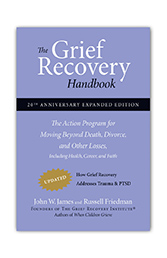
Sadly, you can’t get them back and talk to them in person, but you can do the next best thing. With the guidance of the actions of the Grief Recovery Method, you can communicate [indirectly] any apologies, forgiveness, or significant emotional statements that express the real feelings you have about what did and didn’t happen.
When you do that, you lift the false burden of guilt, which allows you to retain the fond memories you have of that person without them turning painful for you.
If you found this Grief Blog article on grief and guilt helpful, you may also want to read 3 Reasons Why Grief is so Challenging


Comments
Dee Bird, Certified Grief & Life Coach/Specialist
I just read about this in your book. It really was an eye opener to me. So I am trying to find a better word to use when I think of my son and how many times I could had done something at the time but didn't. I have learned so much from your book, Grief Recovery Handbook. Thank you.
www.RememberingTimothy.org
Anonymous
Dee, thank you so much for your comment. We are delighted to hear that the book has helped you!
Lindsay Smith
Maria Sanchez
stephen moeller, grief recovery specialist
Becca
I just read some interesting articles on something called "hindsight bias". Hindsight bias is (according to the following definition obtained from Wikipedia): "Hindsight bias, also known as the knew-it-all-along effect or creeping determinism, is the inclination, after an event has occurred, to see the event as having been predictable, despite there having been little or no objective basis for predicting it.[1][2] It is a multifaceted phenomenon that can affect different stages of designs, processes, contexts, and situations.[3] Hindsight bias may cause memory distortion, where the recollection and reconstruction of content can lead to false theoretical outcomes. It has been suggested that the effect can cause extreme methodological problems while trying to analyze, understand, and interpret results in experimental studies. A basic example of the hindsight bias is when, after viewing the outcome of a potentially unforeseeable event, a person believes he or she "knew it all along". Such examples are present in the writings of historians describing outcomes of battles, physicians recalling clinical trials, and in judicial systems trying to attribute responsibility and predictability of accidents.[4]".
It seems hindsight bias could be applied in many cases of guilt due to grief. We think we should have known, or in fact we believe we DID know what the outcome was going to be in a given situation, and we blame ourselves for not doing more to prevent that outcome. We run the various possible outcomes through our mind, and begin to engage in "if only I'd done this or said that instead, I could have saved _________" (fill in the blank with your deceased loved one). We begin to engage in a sort of "magical thinking", the definition of this term also being obtained from Wikipedia, with the psychological definition being especially apropos I believe, in the case of grieving and guilt: "Magical thinking is a term used in anthropology and psychology, denoting the fallacious attribution of causal relationships between actions and events, with subtle differences in meaning between the two fields. In anthropology, it denotes the attribution of causality between entities grouped with one another (coincidence) or similar to one another. In psychology, the entities between which a causal relation has to be posited are more strictly delineated; here it denotes the belief that one's thoughts by themselves can bring about effects in the world or that thinking something corresponds with doing it.[1] In both cases, the belief can cause a person to experience fear, seemingly not rationally justifiable to an observer outside the belief system, of performing certain acts or having certain thoughts because of an assumed correlation between doing so and threatening calamities."
It has helped me in dealing with my OWN guilt in grieving the loss of my husband a few months ago. I am working to put the "coulda, woulda, shouldas" in perspective, realizing that ultimately my husband made some bad choices that led to his heart attack, going against advice of doctors, myself, and other family members. When all is said and done, we cannot make a person listen to us or choose to engage in the behaviors we would like them to. They must make those choices. If they want to be persuaded, they will be. If they don't want to be persuaded, they won't be - despite our thoughts to the contrary.
Amanda
This article has really helped, my papa passed away a few weeks ago, after suffering with cancer for a few months. He was so strong and independent before he got sick, seeing him like that was very hard for my family, especially my father. My dad and I already had a very rough relationship, I moved away very young and that seemed to be the only way we could get along. But my papa always missed me and wished I would come home. When he got sick I would go see him as much as possible, but it was a long drive, and I still believe my dad didn’t want me there. So it was always a very uncomfortable situation. The last day I saw my grandpa, I had to work late so I only caught the last few minutes of the visit by the time I arrived, and my grandpa asked me to come over the next day and I promised that I would. I ended up fighting with my father that night, and never went to see my grandpa the next day even though I promised. He died a few days later. So his last memory of me was that I never came to visit. He was the only male figure in my life that i loved and trusted with all my heart and sole. I just want to tell him I’m sorry
Quentin Trumiel
My dog was my best friend we use to do so much stuff together went on alot of trips, vacations,camping, hiking sometimes she would get loose and wonder off then i would have to go and find her or she would just come back but one day she had got out and i told myself that she will be back sooner or later the next day I went out searching for her put flyers around my neighborhood and online 6 days had pass and i was getting very worried then i had gotten a call from a man saying that he found my dog he told me that he tried to scare her away but when he went outside the next day my dog was on his porch and she was freezing so he let her stay in his house for two days took her to the vet when he drop her off the vet gave this guy a choice to keep her or put her down and he said that he could not keep her so they put her down after they did that he seen my flyer i put upi feel guilty that i didnt go out looking for her right when i notice she was gone i feel guilty that she was out in the cold lost and i think about how scared she was i know that she wanted me and I wasn’t there now i have to live with this guilt for the rest of my life every time i think about the whole Situation i brings tears to my eyes i can’t believe I failed her my best friend
Amy
I just went to a memorial for my high school sweetheart. He was my first love. We broke up when I went away to college. It was devastating at the time, but I moved on, had several other relationships, and eventually married a great man and had 2 beautiful kids. I thought about him every once in a while. But was well over the drama of our past. Several years ago I ran into his sister and found out he was sick. He had had a kidney transplant that never really went right. He was divorced with a young son, living far away. I sent a card saying I was thinking of him. He texted and we kept in touch. I didn't mind hearing from him and liked to know he was doing ok. My husband knew, but it still felt strange to me, even though it was all above board. No innuendo or flirting; just friendship and hoping he was getting better. I guess I always thought we would see each other again. It had been 25 years. Eventually the texting petered out. Life got busy. Then I got the call.
At the memorial his family told me that I was very important to him. His mom said she wished we had gotten married. His brother recalled how fun and funny it was to watch his older brother fall in love. I left more confused than ever. My simple sadness over a 46 year old life lost is muddy and uncomfortable. I can't stop crying. I feel so much regret that I let that final stage of friendship trail off. Please please help...
Philippa
I recently lost a very close friend to cancer. She was ill for a long time and her illness was very debiltating. On diagnosis I promised her I'd do anything I could to help her get through this awful time. I did genuinely try to do whatever I could. I took her to hosptal visits and texted her daily fo ask if there was anything else I could do. My offers were mainly turned down because she rarely felt well enough to see me, prefering her husband to care for her if she felt really bad. I think I did what I could. I was with her when she died and promised her again I'd do whatever possible to help her husband and kids. I now have some periods of deep grief when I just want to do notging except think about our friendship but I'm trying tp pick myself up and start to move on, but I now find that if I forget about things for a little while, and actually start to enjoy myself, I stop myself and feel horribly sad and guilty...
A Vaz
I feel extremely guilty and depressed. I blame myself for my father's death just a few days ago. He tripped over a bag that I forgot to remove from the 1st floor and fell down to the ground floor in our house. Waking up or going to sleep is a nightmare, every second I keep thinking if only I had moved the bag, he would never have tripped and fallen over. How do you deal with such guilt when you know it is completely, irrevocably your fault?
sarah
My mum died a few weeks ago and I feel guilt that I didn't take her to the doctor when I first noticed her symptoms. she died from heart failure and although she was fine in herself as in eating, going out I did notice she had purple fingertips and knew it was due to poor circulation but I would tell her to move more. I was her full time carer and she had a brain bleed (sah) 11 years ago so had limited mobility but I thought her purple fingertips were due to not moving more so I would try to get her to walk around the garden and do chair exercises especially during lockdown. Then a couple of weeks before she died I noticed her feet and ankles swelling and I put it down to her doing more exercise & not being used to it. I should have taken her to the doctor when I first noticed the symptom of her finger tips changing colour. Instead a week before she died I phoned the GP and he prescribed her with antibiotics and water tablets over the phone because he wasn't seeing patients due to the covid pandemic. 3 days later she had worsened so I called an ambulance and the hospital emergency department diagnosed her with heart failure and she died 3 days later in hospital all alone. I suffer terrible guilt that its my fault she died. If I had taken her to the doctor before the lockdown she may still be here today. I never realised she had a heart condition. All through her brain bleed her heart had been strong. I feel like if I had been more vigilant the doctors would have been able to do more and save her.
pharmacies shipping to usa
I'm really enjoying the theme/design of your web site. Do you ever run into any internet browser compatibility issues? A handful of my blog audience have complained about my website not operating correctly in Explorer but looks great in Firefox. Do you have any solutions to help fix this issue?
Add new comment